
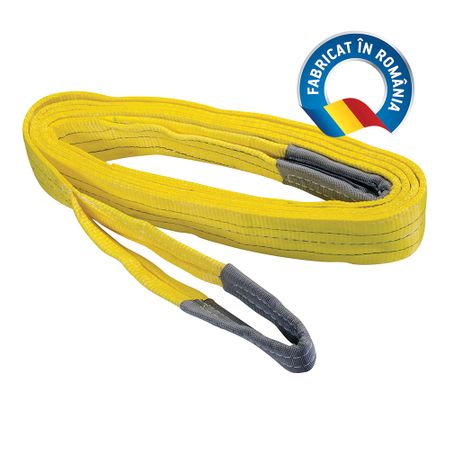
3 t webbing sling with eyes, 2-ply
yellow EN 1492-1 safety factor 7:1 2-ply width 90 mm made in-house by EL-CAR
The 3 t webbing sling with eyes, yellow, 2-ply, covers the medium loads encountered daily in workshops, warehouses and on building sites: machine tools, small containers, pipes, light beams or loaded pallets. The 90 mm width spreads the pressure over a larger surface than a narrow sling, which matters for parts with delicate paintwork. Yellow is the standard colour for this capacity and makes it easier to sort slings in a warehouse. Lengths start at 2 m and go up to 10 m; other lengths can be made on request.
Straight
3,000 kg
Choke hitch
2,400 kg
Basket hitch, parallel legs
6,000 kg
Width
90 mm
Plies
2
Lengths
2–10 m
Working load limit by lifting mode

Straight
single vertical leg · factor 1.0
3,000 kg

Choke hitch
choked · factor 0.8
2,400 kg

Basket hitch
parallel legs, β ≤ 7° · factor 2.0
6,000 kg

Basket hitch
β 7°–45° · factor 1.4
4,200 kg

Basket hitch
β 45°–60° · factor 1.0
3,000 kg

Two slings, straight
β ≤ 45° · factor 1.4
4,200 kg

Two slings, straight
β 45°–60° · factor 1.0
3,000 kg

Two slings, choke hitch
β ≤ 45° · factor 1.12
3,360 kg

Two slings, choke hitch
β 45°–60° · factor 0.8
2,400 kg
β is the angle between the sling leg and the vertical. Lifting at an angle β above 60° is prohibited. The values in the table are the maximum mass of the load for the lifting mode indicated, for a load that is centred and distributed evenly across the legs. The sling label always takes precedence.
Technical specifications
| Working load limit (straight) | 3,000 kg |
|---|---|
| Colour (EN 1492-1 code) | yellow |
| Webbing width | 90 mm |
| Number of plies | 2 |
| Material | polyester (PES) |
| Eyes | woven and reinforced |
| Standard | EN 1492-1 |
| Safety factor | 7:1 |
| Label | blue (polyester), stitched to the sling |
| Working temperature | −40 °C … +100 °C |
| Lengths | 2; 3; 4; 5; 6; 7; 8; 9; 10 m (other lengths on request) |
| Production | EL-CAR’s own workshop |
Sling length

For webbing slings with eyes, the length is the effective working length (EWL): the distance measured between the ends of the eyes, that is, between the bearing points on the hook or other lifting accessory. The eyes are woven and reinforced, and their length is not added to the effective working length.
To choose the length, measure the distance between the hook and the attachment point on the load, and take the lifting mode into account: in a choke hitch or basket hitch, the sling goes around the load and needs more length than in a straight lift. Longer legs help keep the angle β to the vertical within the limits given in the table. If the length you need is not available, we make the sling to order, to the length you require.
2-ply or 4-ply
Webbing slings with eyes are made in 2-ply (1–10 t) and 4-ply (2–20 t). At the same webbing width, the 4-ply sling has twice the capacity of the 2-ply sling; the webbing is, however, thicker and stiffer. 4-ply slings are made to order.
Choose the 2-ply sling for ordinary lifts, where a wider webbing is not a problem. Choose the 4-ply sling when the slinging space is narrow (the same load on a narrower webbing) or when you need a high capacity. Always check the working load limit for the lifting mode you use in the table on this page.
Recommended uses
- Machine tools and medium machinery
- Light beams and sections on building sites
- Pipes and small precast units
- Lifts in the warehouse and at the loading dock
How to choose the sling
- Capacity: choose a sling whose working load limit, for the lifting mode you use, is at least equal to the mass of the load; take the value from the load table, not just the nominal capacity.
- Lifting mode: straight lift (factor 1.0), choke hitch (0.8) or basket hitch (2.0, 1.4 or 1.0, depending on the angle); the same sling has a different working load limit in each mode.
- Leg angle: when lifting with two slings or in a basket hitch, check the angle β to the vertical; do not lift at an angle β above 60°.
- Effective working length: measure the distance between the bearing points and allow for the way the sling passes around the load; the eyes are not added to the length.
- Number of plies: 2-ply for ordinary lifts, 4-ply when the slinging space is narrow or a high capacity is needed.
Correct use
- Use edge protection wherever the sling bears on sharp edges.
- Do not use a knotted or twisted sling.
- Do not drag the sling along the ground or pull it out from under the load.
- Avoid jerking and shock loading when slinging and lifting the load.
- Centre the load and distribute it evenly across the sling or between the legs.
- Seat the eye freely on the hook or in the ring, without forcing or crushing it.
- Use the sling at temperatures between −40 °C and +100 °C. Polyester is attacked by strong alkalis; do not use the sling where such substances are present.
- Store the sling in a dry place, away from sunlight and heat sources.
Inspection and discard
- Inspect the sling visually before every use.
- The sling must be examined by a competent person at least once every 12 months, or more often depending on working conditions and the regulations in force.
- Discard the sling if the webbing has cuts, broken yarns, damaged edges or excessive wear, or if it has knots.
- Discard the sling if it has broken or loose stitching or damaged eyes.
- Discard the sling if the label is missing or no longer legible.
- Discard the sling if it has glazed, melted or stiff areas, or signs of heat, friction or weld spatter.
- Discard the sling if it shows signs of chemical attack, deformation or foreign particles embedded in the webbing.
Marking and label
- Every sling has a stitched label; the label for polyester is blue.
- The capacity can also be identified by the colour of the webbing: 1 t violet, 2 t green, 3 t yellow, 4 t grey, 5 t red, 6 t brown, 8 t blue, orange from 10 t upwards.
- Flat slings made of synthetic fibres are manufactured to EN 1492-1, with a safety factor of 7:1. EN 1492-2 applies to round slings (tubular).
- Do not use a sling without a legible label.
EL-CAR’s own workshop
EL-CAR makes webbing slings with eyes in its own workshop, in 2-ply and 4-ply versions. 2-ply slings are made in the lengths shown in the table, and other lengths are made on request; 4-ply slings are made to order, with the length set when the order is confirmed.
Ordering, delivery and returns
4-ply slings and slings with special lengths are made to order and are excluded from the right of return, in accordance with Article 12.2 of the Terms and Conditions. The delivery time is given when the order is confirmed. Images are for illustration only.
Frequently asked questions
How is the length of a webbing sling with eyes measured?
The length is the effective working length, measured between the ends of the eyes, that is, between the bearing points on the hook or other lifting accessory.
What is the difference between a 2-ply and a 4-ply sling?
At the same webbing width, the 4-ply sling has twice the capacity, but the webbing is thicker and stiffer. Choose it when the slinging space is narrow (the same load on a narrower webbing) or when you need a high capacity.
What sling capacity should I choose?
Choose the capacity according to the mass of the load and the lifting mode, reading the working load limit from the table on the page. Compared with a straight lift (factor 1.0), the same sling can lift more in a basket hitch with parallel legs (factor 2.0) and less in a choke hitch (factor 0.8).
How often should a webbing sling with eyes be inspected?
The sling must be inspected visually before every use. In addition, it must be examined by a competent person at least once every 12 months, or more often depending on working conditions and the regulations in force.
When should I discard the sling?
Discard the sling if the webbing has cuts, broken yarns, damaged edges or excessive wear; if it has glazed, melted or stiff areas, or signs of heat, friction or chemical attack; if it has broken stitching, damaged eyes or knots; or if the label is missing or can no longer be read.
Can 4-ply slings or slings with a special length be returned?
No. 4-ply slings and slings with special lengths are made to order and are excluded from the right of return, in accordance with Article 12.2 of the Terms and Conditions.


Reviews
There are no reviews yet.